Case study
ZF Halo
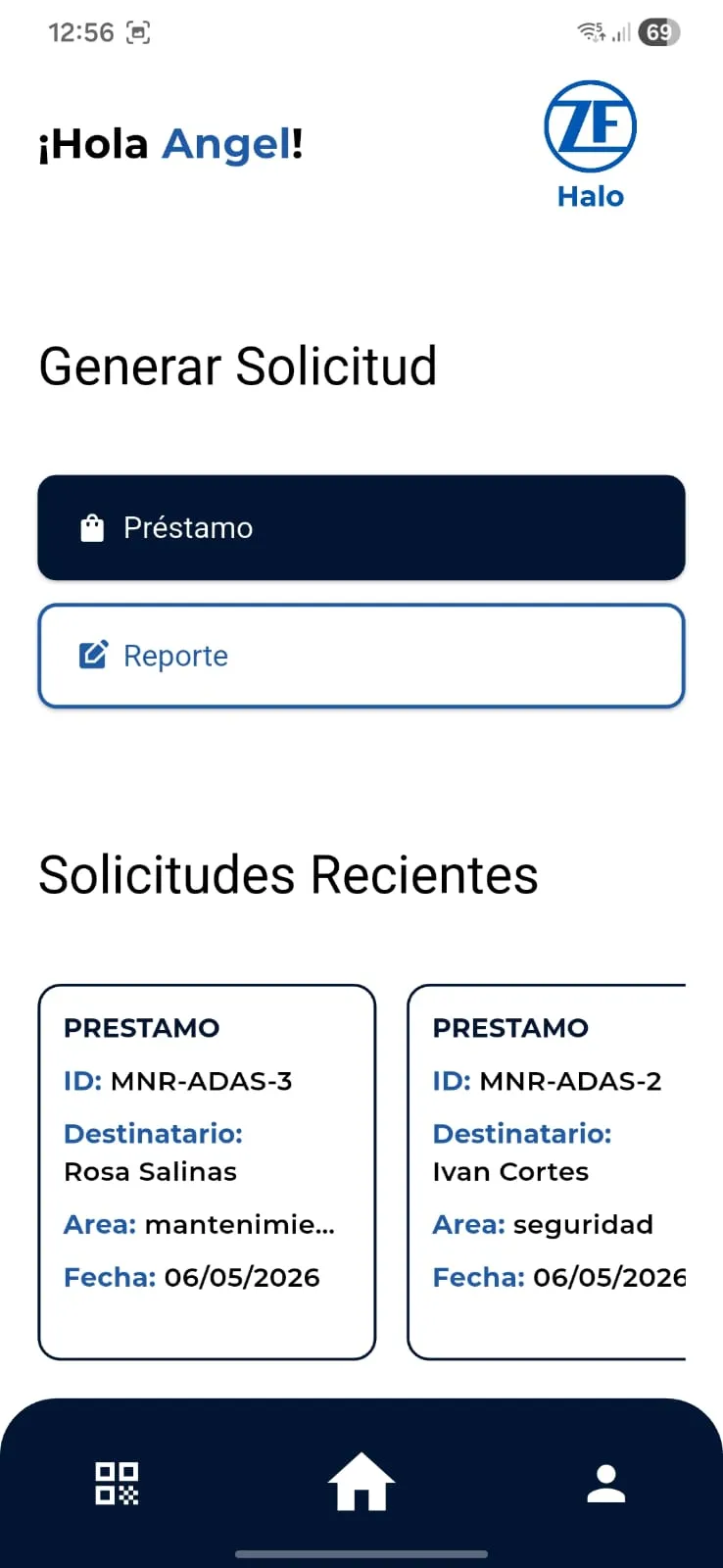
Comprehensive system to manage the lifecycle of the prototype inventory at the ZF laboratory in Monterrey.
- Role
- Development lead, Full-Stack developer
- Company / Context
- Innovation MeetUp · ZF Engineering
- Period
- Feb — May 2026
- Stack
- Flutter · React · ASP .NET · Entity Framework Core
Android · Flutter

(01) Context & problem
ZF needed better control over the checkout of its lab assets used for research and development. The goal was to know where each one is and ensure responsible use and on-time return, reducing losses and keeping them available.
(02) My role
Leading the team in developing the proposal and prototype, as well as building part of the prototype presented at the competition.
(03) Solution & key decisions
- —The prototype was built in Flutter to make building for both iOS and Android easier.
- —AWS services were proposed so the system would be redundant and scale horizontally as adoption and traffic grew, since it was envisioned that it could expand internationally.
- —The user interface was designed with simplicity in mind, since the application would be used by a wide variety of employees, with some devices being kiosks only, so security staff could receive items or generate inventory checkouts.
- —A QR code-based asset identification system was implemented so that operations with assets on the platform were simpler and, as far as possible, did not require manual data entry.
- —An incidents and maintenance module was added so the inventory was not limited to present or not present, but temporary removals for maintenance or failures could also be scheduled and the information would be available for auditing.
- —Authentication with Entra ID through AWS Cognito was implemented so the application did not require dedicated credentials but used the ones employees already knew, making the system more secure.
- —AI was implemented with AWS Bedrock to generate reports with interpretations summarizing what the data showed, as well as to provide assistance from the admin panel, where data can be queried in human language to get precise answers based on that data.
(04) Technical challenge
The biggest challenge when designing the solution was defining the system architecture, since data security and integrity were essential. For that reason, several AWS services were used to monitor operations efficiently and keep the risk of data leaks to a minimum, while also offering a good development experience by implementing a CI/CD pipeline using GitHub Actions, ECR and ECS Fargate to deploy new changes.
(05) Outcome
The project was selected nationally and presented in Cancún as part of IMU26.
(06) Gallery
Pantalla de inicio
01 / 17